


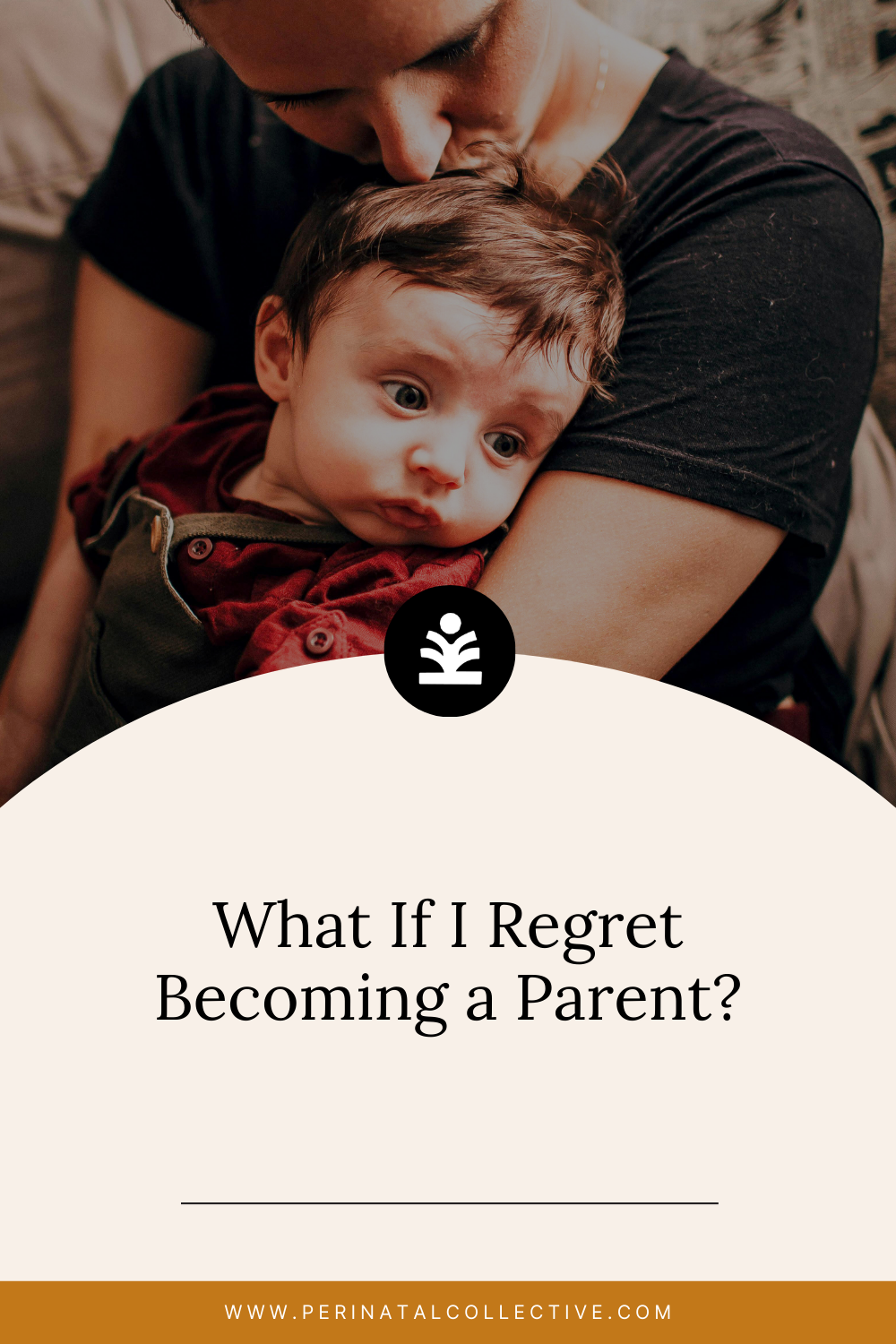
“What if I regret this?”
For many people, that thought can start slow but then quickly spiral. It can show up while trying to conceive, during pregnancy, or even while actively deciding whether to have children. The fear of becoming a regretful parent can feel frightening and isolating. It often arrives with a heavy layer of shame.
This is a very common but rarely spoken fear. Cultural expectations tell us that becoming a parent is supposed to feel joyful and deeply fulfilling, so when doubt shows up instead, many people assume something is wrong with them (and are afraid to say it outloud).
In our counselling rooms, we hear this so often, and it also show up in our Instagram DMs, and emails that begin with, “I’ve never said this out loud before…” There are particularly strong expectations placed on mothers to feel grateful and completely sure of their decision to become a mom, as if it’s some kind of given (which is a myth). So if you’re noticing mixed or complicated emotions already, you are so not alone, and you may also relate to our post on pregnancy ambivalence.
When other feelings exist alongside (or instead of) gratitude, like fear, grief, uncertainty, even dread, it can feel deeply disorienting. But having complicated feelings does not make you a bad person, and it doesn’t mean you’re doing this wrong.
Why the Fear of Regret Shows Up So Strongly
Pregnancy and the transition to parenthood understandably leads to profound change in a person’s life. They affect everything from identity, relationships, finances, lifestyle, work, to long-term plans. Even when a pregnancy or parenting decision is very much wanted, the magnitude of the shift can feel overwhelming.
Becoming a parent involves so much permanence, it’s life-changing, and there is no trial period. So it’s completely understandable that this reality can stir up fear about responsibility and long-term impact. It can also bring imagined future losses into focus, like your freedom, spontaneity, independence, flexibility, sleep, ease, and so many other things.
For many women in particular, the career impact feels even more significant that it does for dads. Because of biological differences in terms of pregnancy, birth and postpartum, as well as structural differences with opportunity, gender stereotypes and discrimination, parenthood can disproportionately affect moms in terms of promotions, pay, leadership opportunities, and how seriously they’re perceived at work. Even in supportive environments, the shift can feel substantial. It may also feel like there is never a perfect time to have children. Careers are still building. Financial goals are still in progress. Relationships are still evolving.
And here’s something we hear a lot with our counselling clients: when you genuinely like your current life, it can feel so scary to pivot away from it. The abrupt loss of independence and autonomy can feel real, even before a baby arrives.
The fear of regretting becoming a parent often reflects the weight of this change. It does not necessarily mean someone is rejecting parenthood or not meant to become kids, but instead, it usually means they understand how significant the transition is.
Is It Normal to Worry About Regretting Parenthood?
Yes. It is very normal to worry about regretting parenthood.
When this fear shows up, it often isn’t just the idea of regret that feels scary. It’s the thought itself. You might notice yourself thinking, “Why did that even cross my mind?” or “What kind of person worries about regretting their own child?” And suddenly the focus shifts. Instead of just feeling uncertain, you start questioning your character, your readiness, even your goodness. The distress becomes less about the future and more about what having the thought seems to say about you.
It can also help to remember that feelings feel convincing. When fear shows up, it can sound authoritative, like it’s delivering a final answer about your future. But feelings are experiences, not decisions. They move and shift. They respond to stress, hormones, sleep, conversations, and expectations.
You can feel scared and still want this. You can feel grief about what’s changing and still feel love for what’s coming. Those states are not opposites. They can exist in the same person, at the same time.
What tends to make this heavier is the shame layered on top. Many people quietly worry, “If I’m afraid I’ll regret this, does that mean I won’t love my child?” In my experience, that’s almost never what’s actually happening. The fear is usually about the weight of parenting (the responsibility, the permanence, the loss of ease) not about rejecting a specific child.
There is space for mixed feelings here. Having them does not cancel out your capacity for love or commitment.
What People Usually Mean When They Say “I’m Afraid I’ll Regret This”
When someone says, “I’m afraid I’ll regret becoming a parent,” they are often pointing to something deeper.
It might be grief for a former life, like the version of you who could travel easily, rest when you wanted, or make spontaneous decisions.
It might be fear of losing autonomy or identity.
It might be worrying about emotional, relational, or financial capacity.
It might be anxiety about what it might feel like to have to learn something new, and not feel confident.
It can also reflect how difficult it is to make such a significant choice without certainty. It makes sense to want to feel completely sure before changing your life in such a permanent way.
Fear and desire can coexist. Anxiety about the future does not automatically equal a hidden wish not to be a parent.
“Does This Mean I Should Not Have Kids?”
This question often follows quickly: “If I’m this afraid, does that mean I shouldn’t do it?”
It is totally understandable to want clarity, and this is something we talk about often in counselling. Fear feels so urgent and persuasive and it tends to create pressure to either move forward confidently or stop entirely.
The challenge is that fear alone is not always a reliable decision-making tool. Anxiety tends to focus on potential loss and worst-case outcomes (the things we don’t want to happen. It is not always rooted in your values or long-term vision.
So instead, we like to encourage people to shift from making choices based on avoiding anxiety to making choices based on what they value.
Instead of asking, “How do I make this fear go away?” it can be more grounding to ask, “What kind of life do I want to build?” or “What feels meaningful to me, even if it’s hard?”
For many people, it is not a clean yes or no (annoying, right? We know). But the truth is that there can be valid reasons on both sides. Loving your current life and wanting children can both be true. Feeling unsure does not automatically mean you are making the wrong decision.
Sometimes this fear is intensified when partners are not in the same emotional place. One person may feel certain and ready, while the other feels hesitant or afraid. That difference can create pressure or guilt, especially if you worry about disappointing someone you love. Slowing the conversation down and acknowledging that mixed feelings do not equal rejection can help. Many couples move through different phases of clarity at different speeds. Creating space for honest dialogue, rather than rushing toward agreement, often leads to more grounded decisions.
Is Life Happier Without Kids?
This question usually shows up when you’re comparing. Maybe you’re watching friends who are child-free travel on short notice, pour themselves into their careers, sleep in on weekends, or make spontaneous plans. And at the same time, you might see parents talking about how meaningful and transformative their experience has been.
It can feel confusing to hold both of those images.
Right now, there’s also a lot of cultural conversation around this. You’ll see strong voices celebrating child-free living. You’ll also see strong voices celebrating parenthood as the most meaningful thing a person can do. Sometimes there’s tension between those camps. Sometimes there’s judgment. And social media tends to amplify the loudest versions of both.
When you’re already feeling unsure, that kind of comparison can make everything louder.
What I often remind clients is that happiness isn’t a single destination you arrive at and stay in forever. Different stages of life bring different kinds of joy and different kinds of stress.
Parenthood can absolutely increase daily responsibility, mental load, and strain. It can also increase meaning, attachment, and a sense of depth in ways people didn’t anticipate. A child-free life can offer freedom, flexibility, and space. It can also include its own forms of longing, grief, or complexity, depending on the person.
There isn’t a universally happier path. There are different paths, each with trade-offs.
So instead of asking, “Which life is happier?” it can be more grounding to ask, “Which life feels more aligned with who I am and what I value?” Not because one is easier, but because alignment tends to feel steadier than comparison.
What to Do When the Fear of Regret Feels Overwhelming
When fear escalates, your nervous system can go into overdrive with endless thought loops and worst-case scenarios feel vivid. Everything feels urgent. Clarity rarely comes from forcing an answer in that state, but instead, it tends to come from slowing down and connecting more with yourself.
This can look like:
- Naming the fear without judging it.
- Reducing exposure to conversations or content that intensify comparison.
- Allowing uncertainty to exist without demanding immediate resolution.
- Talking openly with someone who understands perinatal mental health.
Curiosity can be more helpful than self-criticism. Instead of trying to eliminate the fear, it can help to explore it gently by asking yourself: what feels most threatening? What feels most meaningful? What losses feel hardest to imagine?
What to Do When You Regret Getting Pregnant
For some people who have already conceived, the fear becomes something more urgent like “I regret this.” Or, “What have I done?”
Early pregnancy can bring intense panic, especially if the pregnancy was unplanned or unwanted. Even in planned pregnancies, reality can land differently than expected. If you’re early in pregnancy and noticing more numbness or flatness than excitement, you might find validation in one of our other posts, So You’re Not That Excited About Being Pregnant.
When regret shows up during pregnancy, it is often rooted in overwhelm. Pregnancy can disrupt your sense of stability in ways that are so hard to anticipate. Your body changes quickly. Your daily rhythms shift. Financial stress might feel much more urgent. And understandably, relationship dynamics can feel different. So when a thought like “I regret this” surfaces, it does not automatically mean you have made the wrong choice. More often, it reflects that something feels unsteady right now and your nervous system is reacting to that shift.
If you are searching for what to do when you regret getting pregnant, it can help to resist the urge to treat that feeling as a permanent conclusion. Instead of asking, “What does this mean about my future?” it can be more supportive to ask, “What feels hardest about this moment?” or “what kind of support do I need right now?” When you slow it down in that way, the feeling often becomes more understandable and less absolute.
We also want to acknowledge that being pro-choice includes the right to pause and consider your options, again, even if this was a wanted pregnancy. Some people use early pregnancy as a time to reflect carefully on whether they want to proceed, rather than moving forward by default.
Resisting self-judgment, reaching out for support, and giving yourself space to think clearly can make a big difference. We want you to know that these feelings are more common than most people admit, especially in the early weeks of pregnancy.
When This Fear Is a Sign You May Need More Support
Sometimes fear of becoming a regretful parent is connected to anxiety, depression, trauma, or a lack of support.
If the fear feels constant or intrusive…
If it is accompanied by persistent low mood, panic, or hopelessness…
If past trauma feels activated by the idea of parenting…
If you feel isolated in your relationship or community…
It may be helpful to speak with a professional who understands perinatal mental health.
Reaching out is not an admission of failure. If you’re unsure whether your experience is “serious enough” to talk to someone about, you may appreciate reading Are My Problems Big Enough to Need Therapy?.
At The Perinatal Collective, our team of perinatal mental health therapists supports individuals and couples across Canada who are navigating pregnancy decisions, ambivalence, and fear about parenthood.
You do not have to silence these thoughts. They are allowed to be spoken out loud.
Frequently Asked Questions
Is it normal to regret becoming a parent after the baby is born?
Some parents experience thoughts of regret in the postpartum period, especially during times of sleep deprivation, hormonal shifts, or isolation. These thoughts often reflect overwhelm rather than a true desire to undo parenthood. When these feelings persist or feel distressing, additional support can help unpack what is underneath them.
Can postpartum depression make you feel like a regretful parent?
Yes. Postpartum depression and anxiety can intensify hopeless or intrusive thoughts, including fears about having made the wrong decision. These conditions can shift how someone feels about themselves, their baby, and their future. When regret feels constant or is accompanied by other symptoms like low mood or panic, reaching out to a perinatal mental health professional can make a meaningful difference.
Is it normal to think “what have I done?” during pregnancy?
Yes. Many people experience moments of panic or doubt after finding out they are pregnant, even in planned pregnancies. These thoughts often reflect the magnitude of the life change rather than a clear desire to undo it. When the initial shock settles and you have space to process, the intensity of those thoughts often shifts.
Does worrying about regret mean I shouldn’t become a parent?
Not necessarily. Fear is a common response to permanent life changes. Worrying about regret does not automatically mean you are making the wrong decision. It often means you understand that this choice matters. Exploring the fear with curiosity rather than urgency can help clarify what is underneath it.




Wonderful blog